
Examples of Actionable Trade Signals for Traders


Actionable trade signals are rule-based triggers that define a precise entry zone, stop-loss level, and profit target before you place a single trade. Unlike raw indicators that tell you what the market is doing, these signals tell you what to do about it, including how much to risk and when to exit. Tools like Big Move Algo and AI-driven platforms have made generating such signals faster and more accessible for retail traders. The core value is not prediction. It is structure: every signal removes the guesswork that causes most traders to lose money.
1. Examples of actionable trade signals and their anatomy
Every actionable trade signal contains four components: an entry zone, a stop-loss or invalidation point, one or more take-profit targets, and a risk/reward ratio. A real Bitcoin oversold-bounce setup from June 2026 illustrates this perfectly. The signal defined an entry zone between $64,800 and $66,000, a stop-loss at $61,800, and three take-profit tiers at $69,100, $72,000, and $74,000. That structure gives you a clear plan before the trade begins, not after.
The risk/reward on that setup was approximately 1:2 on the first target and better than 1:3 on the third. That means one winning trade covers two or three losing ones at the same position size. Without those numbers defined upfront, most traders either exit too early or hold too long.

Pro Tip: Never enter a signal without confirming all four components are present. If a signal gives you an entry but no stop-loss, it is not a trade setup. It is a guess.
Component | Example (Bitcoin June 2026) |
Entry zone | $64,800 to $66,000 |
Stop-loss | $61,800 |
Take-profit tiers | $69,100 / $72,000 / $74,000 |
Risk/reward ratio | 1:2 to 1:3+ |
2. Moving Average crossover signals
The Moving Average crossover is one of the most widely used examples of trading indicators in practice. The signal triggers when a shorter-period moving average crosses above or below a longer-period one. A common setup uses the 50-period and 200-period simple moving averages on a daily chart. When the 50 crosses above the 200, the signal is long. When it crosses below, the signal is short or exit.
The entry is placed at the close of the candle that confirms the crossover, not at the moment of the cross itself. The stop-loss sits below the most recent swing low for long trades, and the take-profit targets the next major resistance level. This structure converts a widely known concept into an operational trade instruction with defined parameters.
The weakness of this signal is lag. By the time the 50/200 cross confirms, a significant portion of the move has already occurred. Traders who use this signal on higher timeframes, such as the daily or weekly chart, reduce false signals at the cost of later entries.
3. Opening Range Breakout (ORB) signals
The Opening Range Breakout is a day-trading signal built around the high and low established in the first 30 minutes of a trading session. The classic version buys a break above the opening range high and sells a break below the low. The improved ORB model adds a daily trend filter and uses stop orders instead of market orders, which prevents chasing price. That single modification produced a 672% profit increase over the classic version in backtesting.
The practical steps matter here. You identify the opening range, set a stop-buy order just above the high or a stop-sell order just below the low, and place your stop-loss at the opposite end of the range. The daily filter means you only take long ORB signals on days when the broader trend is up, and short signals when it is down. This is what converts a popular theory into real profit.
Pro Tip: Limit yourself to one or two ORB trades per session. The improved model’s edge comes from selectivity, not volume. More trades dilute the statistical advantage.
4. Oversold RSI bounce signals
An oversold RSI bounce signal triggers when the Relative Strength Index drops below a defined threshold, typically 20 or 30, and then begins to recover. A June 2026 Bitcoin setup showed a daily RSI of 18.20 alongside a Fear and Greed Index reading of 11, which is extreme fear territory. Both readings together created a high-probability contrarian long setup.
The entry zone was defined by the most recent support level, the stop-loss was placed below the swing low, and the take-profit targeted the nearest resistance. The Fear and Greed Index reading below 20 functions as a secondary confirmation filter. It tells you the crowd is positioned heavily to one side, which historically precedes short-term relief bounces in Bitcoin and other liquid assets.
This signal type works best on daily or weekly timeframes where RSI extremes are statistically meaningful. On 5-minute charts, RSI below 20 is common and carries far less predictive weight.
5. How machine learning improves signal quality
Machine learning models generate trade signals by identifying patterns across hundreds of variables simultaneously, including price action, volume, and candlestick formations. Research shows that ML forecast strategies outperform buy-and-hold on average when transaction costs are low and market conditions are favorable. That outperformance is not guaranteed, but it is statistically significant across multiple asset classes.
The key distinction is operational design. An ML model that outputs a probability score is not an actionable signal. An ML model that outputs “buy at $X, stop at $Y, target $Z” is. Incorporating candlestick patterns into ML models improved annualized excess returns when forecasting SPY and Bitcoin price direction. This means the visual patterns traders have used for decades carry genuine statistical weight when processed correctly.
Platforms like Big Move Algo apply this logic by combining technical analysis with algorithmic filtering to produce clear Long, Short, and Exit signals. The built-in Fake Trend Detector filters out low-quality market conditions where the signal-to-noise ratio is too high to trade reliably.
ML signals must define explicit entry and exit rules to be truly actionable
Scoring functions like the Sharpe ratio and Calmar ratio help select the best-performing signal variants
Candlestick pattern features improve ML model accuracy for both crypto and equity markets
AI-driven platforms provide operational trade instructions rather than raw data outputs
6. Risk management built into every signal
A trade signal without a risk management framework is incomplete. The four-layer risk system used by professional traders covers position sizing, stop placement, daily loss limits, and drawdown management. Each layer serves a different function, and all four must be active simultaneously.
On a $50,000 account, the standard rule is to risk no more than 1% per trade, which equals $500. The daily loss limit is typically set at 3%, or $1,500. If you hit that limit, trading stops for the day regardless of how confident you feel about the next setup. These numbers are not arbitrary. They protect your account from the kind of compounding losses that wipe out traders who ignore them.
Pro Tip: Set your daily loss limit as a hard stop in your trading platform, not just a mental note. Discretionary limits get overridden under pressure. Automated limits do not.
The most common cause of losses exceeding planned risk is moving stop-losses after entry. Traders tell themselves the setup is still valid and widen the stop to avoid being stopped out. This breaks the risk/reward calculation that made the signal worth taking in the first place.
Risk layer | Common mistake |
Position sizing (1% per trade) | Oversizing after a winning streak |
Stop placement (below swing low) | Moving stop further away after entry |
Daily loss limit (3% of account) | Ignoring limit and continuing to trade |
Drawdown management | No rule for reducing size after losses |
7. Comparing top actionable trading signal platforms
The best platforms for effective trading signals share three features: clear entry and exit instructions, defined stop-loss levels, and a documented win rate. Here is how the leading options compare.
Big Move Algo operates as a TradingView indicator that delivers Long, Short, and Exit signals in real time across crypto, forex, stocks, indices, and commodities. The platform reports up to 92% win rate signals with defined entry, stop, and profit parameters. AUTO Mode requires minimal setup, making it accessible for traders who want structure without complexity.
Holly (by Trade Ideas) is an AI-driven scanner that generates pre-market trade ideas with entry and exit points. It focuses primarily on U.S. equities and is designed for active day traders who want AI-filtered setups each morning.
DisciplineAI is an AI-powered platform that generates operational trade signals with clear entry and exit rules, with a focus on helping traders identify and correct performance patterns that cost them money.
Big Move Algo: multi-market coverage, TradingView integration, Fake Trend Detector, AUTO and Manual modes
Holly: U.S. equity focus, pre-market AI scans, strong community support
DisciplineAI: performance pattern analysis, trade signal validation, behavioral coaching layer
The right platform depends on your market and experience level. Big Move Algo suits traders who want a single tool that works across multiple asset classes without requiring deep technical knowledge.
Key takeaways
Actionable trade signals require four defined components: entry zone, stop-loss, take-profit targets, and a risk/reward ratio calculated before the trade is placed.
Point | Details |
Signal anatomy | Every signal needs entry, stop-loss, take-profit, and risk/reward defined upfront. |
ML signal advantage | Machine learning signals outperform buy-and-hold when transaction costs are low and design is operational. |
ORB improvement | Adding a daily filter and stop orders to the classic ORB model produced 672% more profit in backtesting. |
Risk management layers | A four-layer system covering position sizing, stops, daily limits, and drawdown protects capital long term. |
Platform selection | Choose platforms that output clear trade instructions, not just raw data or probability scores. |
Why signal discipline matters more than signal quality
I have reviewed dozens of trading systems over the years, and the pattern that separates profitable traders from losing ones is almost never signal quality. It is execution discipline. Traders who use a mediocre signal with strict rules consistently outperform traders who use a statistically superior signal but override it based on gut feeling.
The most dangerous moment in signal trading is right after a losing trade. That is when traders start moving stops, doubling position sizes, or ignoring the daily loss limit. I have seen traders blow up accounts that were profitable on paper because they abandoned the rules during a three-trade losing streak. A losing streak is not a signal failure. It is a normal statistical event that every edge-based system experiences.
My recommendation is to treat your signal’s stop-loss as a contract, not a suggestion. If the market hits your stop, the trade is over. The signal was wrong for that instance, and that is acceptable. What is not acceptable is rewriting the rules mid-trade because you do not want to take the loss. That behavior compounds losses in ways that no signal, regardless of win rate, can overcome.
If you are evaluating a new signal system, backtest it across at least 100 trades before committing real capital. Look at the performance patterns that emerge, not just the win rate. A system with a 60% win rate and a 1:2 risk/reward is mathematically superior to a 75% win rate system with a 1:0.8 risk/reward. Most traders pick the higher win rate because it feels better. The math does not care how it feels.
— Steven Hartwell
See real trade signals in action with Big Move Algo
If you want to stop analyzing and start executing with confidence, Big Move Algo delivers exactly what this article describes: clear Long, Short, and Exit signals with defined entry points, stop-loss levels, and profit targets built in.
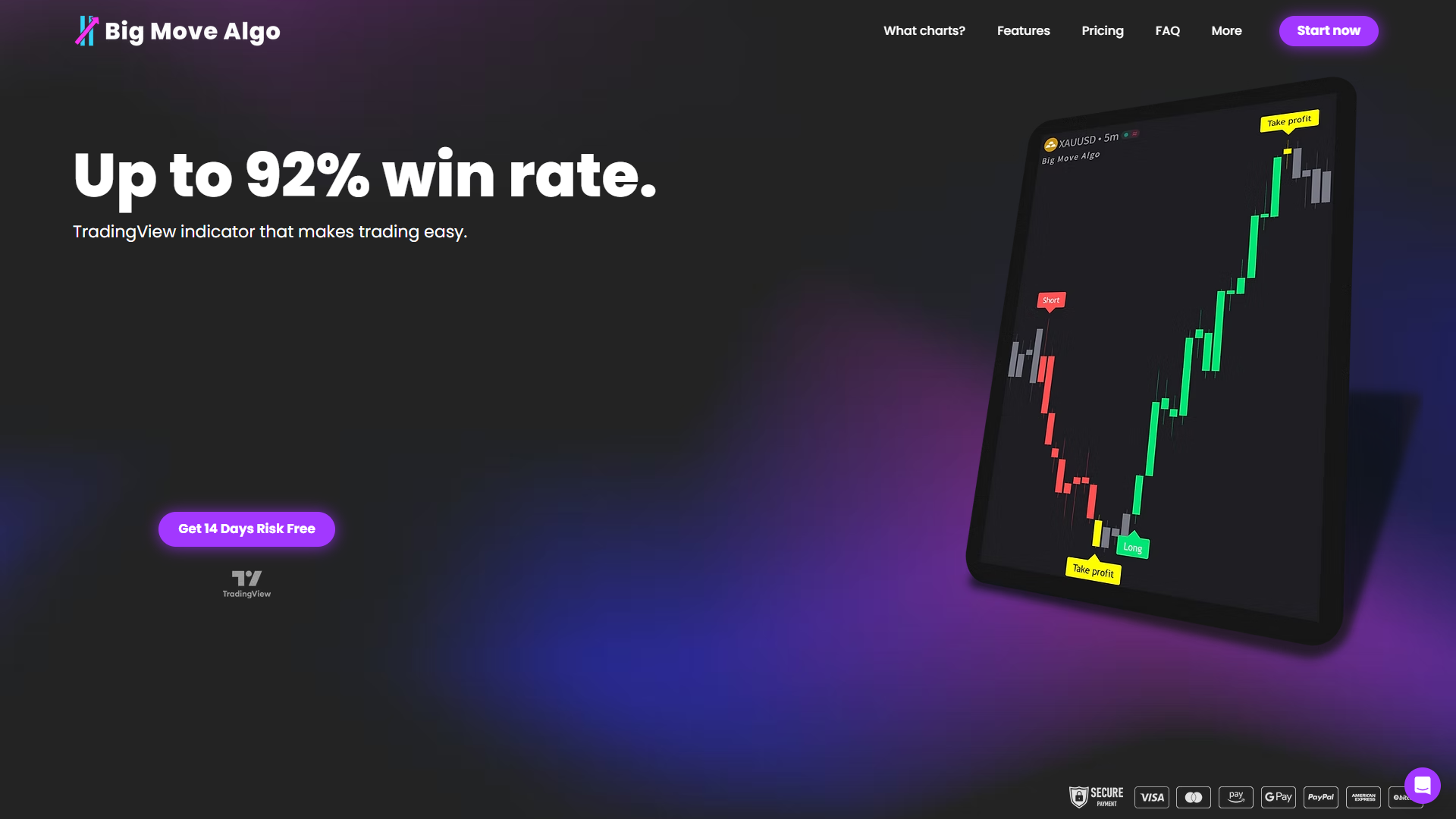
Big Move Algo works across crypto, forex, stocks, indices, and commodities directly inside TradingView. The built-in Fake Trend Detector filters out low-quality conditions so you are not trading noise. AUTO Mode gets you running in minutes, and the platform’s up to 92% win rate signals are structured to give you a statistical edge from day one. If you want to see how the signals work before committing, the how-to guide walks through every feature with practical examples.
FAQ
What makes a trade signal “actionable”?
An actionable trade signal specifies a precise entry zone, stop-loss level, and at least one take-profit target before the trade is placed. Signals that only indicate market direction without defining risk parameters are not considered actionable.
How do I identify a high-quality trade signal?
A high-quality signal includes a defined risk/reward ratio of at least 1:2, a clear invalidation point, and a documented win rate based on backtesting across a meaningful sample size. Signals generated by ML models that incorporate candlestick patterns alongside financial variables tend to show stronger statistical performance.
What is the Opening Range Breakout signal?
The Opening Range Breakout signal uses the high and low of the first 30 minutes of a trading session as the trigger zone. The improved ORB model adds a daily trend filter and stop orders, which produced 672% more profit than the classic version in backtesting.
How much should I risk per trade signal?
The standard rule is to risk no more than 1% of your total account per trade, with a daily loss limit of 3%. On a $50,000 account, that means a maximum of $500 per trade and $1,500 per day before stopping all trading activity.
Can machine learning signals outperform traditional indicators?
ML-based trading strategies outperform buy-and-hold on average when transaction costs are low and the model is designed with explicit entry and exit rules. Adding candlestick pattern features to ML models has been shown to improve annualized excess returns for both SPY and Bitcoin.
Recommended
Comments