Benefits of Automated Trade Signals for Smarter Trading
Automated trade signals are algorithm-driven alerts that identify buy, sell, or exit opportunities in real time, making them one of the most practical tools available to modern traders and investors. In the industry, these are often called algorithmic signals or systematic trading alerts. The benefits of automated trade signals extend well beyond simple convenience. They remove emotional bias, enforce risk discipline, and give you access to market opportunities that manual scanning simply cannot match. Whether you trade crypto, forex, or equities, understanding these advantages is the first step toward a more structured, consistent trading process.
1. How automated trade signals save time and boost efficiency
Time is the scarcest resource in trading. Markets move fast, and manual scanning across multiple charts, timeframes, and assets is physically exhausting. Automated signal systems solve this by monitoring markets around the clock without fatigue or distraction.
Signal bots operate relentlessly, executing trades instantly when trigger conditions are met, unlike human traders who are constrained by schedules and energy levels. This means setups that appear at 3 a.m. or during a lunch break are captured automatically. The practical result is that you stop missing trades simply because you were not watching.
The efficiency gains compound quickly. Capturing 2-3 additional setups per month through automated 24/7 monitoring leads to 15-25% higher annual returns compared to manual trading. That figure reflects the real cost of missed opportunities, not just the value of faster execution.
Key efficiency advantages include:
- Simultaneous scanning of dozens of assets across multiple markets
- Instant alert delivery via TradingView, email, or mobile notifications
- Elimination of manual chart-checking routines that consume hours daily
- Consistent signal timing regardless of your personal schedule or time zone
Pro Tip: Pair your automated signals with platform alerts so that every trigger reaches your phone in real time. Big Move Algo integrates directly with TradingView’s alert system, meaning you get notified the moment a Long, Short, or Exit signal fires.
2. How signals reduce emotional bias and human error
Emotional decision-making is the single biggest destroyer of trading accounts. Fear causes premature exits. Greed pushes traders to hold losing positions. Automated signals remove that variable entirely by enforcing predefined rules on every trade.
Automated trading systems reduce human error such as mistyped order sizes and hesitation, ensuring strict adherence to risk management plans on every execution. The algorithm does not second-guess itself. It does not freeze during a volatile candle or chase a trade that already moved. That consistency is worth more than most traders realize until they experience a costly emotional mistake firsthand.
The psychological protection extends beyond individual trades. When you follow a signal system with a documented track record, you trade with confidence rather than anxiety. You know the rules, and the system enforces them.
“Signals are emotional armor in volatile markets. They replace the question ‘should I take this trade?’ with a clear, rule-based answer that removes hesitation from the equation entirely.”
Specific error types that automated signals eliminate:
- Impulsive entries based on fear of missing out
- Holding losing trades past stop-loss levels due to hope
- Oversizing positions during winning streaks
- Skipping valid setups due to recent losses affecting confidence
You can learn more about how signals remove trading guesswork and why that matters for long-term account preservation.
3. How automated signals enhance accuracy and strategy discipline
Accuracy in trading is not about being right every time. It is about executing your strategy correctly, every time. Automated signals enforce that discipline in ways that manual trading rarely achieves.
High-quality signals include pre-calculated stop-loss and take-profit levels, ensuring defined risk parameters on every trade to protect capital. This embedded structure means you are not improvising risk management in the heat of a trade. The parameters are set before the signal fires, and you execute accordingly.
Backtesting is the foundation of signal accuracy. Backtesting automated strategies provides emotional confidence during live trading by showing historical drawdown and recovery patterns, which prevents panic exits during normal losing streaks. A signal system with three years of backtested data tells you exactly what to expect, so a five-trade losing run does not shake your conviction.
Steps to maximize signal accuracy in your trading:
- Verify the signal provider’s backtested win rate across multiple market conditions, not just bull markets
- Cross-reference signals with your own market context analysis before execution
- Track every signal taken and missed in a trading journal to identify patterns
- Monitor signals daily to catch anomalies, such as signals firing in low-liquidity conditions
Pro Tip: Big Move Algo’s built-in Fake Trend Detector filters out low-quality market conditions before a signal fires. This single feature prevents a large category of false entries that would otherwise damage your win rate.
For a deeper look at getting precise directional alerts, the guide on clear Long Short signals walks through the mechanics in detail.
4. Diversification and multi-market coverage
Manual traders are limited by attention. You can realistically monitor three to five markets with consistent quality. Automated signal systems face no such constraint, which creates a genuine diversification advantage.
Professional signal services cover multiple asset classes, enabling diversification and exposure to opportunities across forex, commodities, equities, and crypto markets. This breadth smooths equity curves because losses in one market are often offset by gains in another. A trader running signals across EUR/USD, Bitcoin, gold, and the S&P 500 simultaneously is far less exposed to any single market event than one focused on a single asset.
Big Move Algo operates across crypto, forex, stocks, indices, and commodities within TradingView, which means the same signal logic applies regardless of which market you are analyzing. You do not need separate tools for each asset class.
Diversification benefits by trader level:
| Trader level | Primary benefit | How signals help |
|---|---|---|
| Beginner | Reduced complexity | Signals identify setups without requiring deep technical knowledge |
| Intermediate | Broader market access | Signals cover asset classes outside the trader’s primary expertise |
| Advanced | Portfolio optimization | Signals enable systematic multi-market exposure with consistent rules |
| Active trader | Speed and coverage | Simultaneous monitoring of dozens of assets without manual effort |
5. Educational value for developing traders
Trading signals are not just execution tools. For developing traders, they function as real-time case studies in market analysis. Each signal that fires shows you exactly which conditions aligned to produce a trade opportunity.
Trading signals act as an educational bridge by showing traders why signals are triggered through indicator alignment and price patterns, helping them learn trade structuring and risk management. A beginner who follows ten signals per week is absorbing ten structured lessons in market behavior, each with a defined entry, stop-loss, and target. That is a faster learning curve than most trading courses offer.
For newer traders, signals demystify market ideas by explaining setups and enabling hands-on learning with real examples. The gap between theory and practice closes quickly when you are executing real trades with clear logic behind each one. The first trading platform checklist is a useful companion resource for traders who are still setting up their environment alongside learning signal-based trading.
Experienced traders benefit differently. Signals reinforce discipline and provide a second opinion that checks against overconfidence. Even a seasoned trader benefits from a systematic filter that removes subjectivity from the entry decision.
6. Consistency across changing market conditions
One of the least discussed trade signals benefits is consistency. Human traders adapt their behavior to recent results, often in counterproductive ways. A losing week leads to hesitation. A winning week leads to overconfidence. Automated signals apply the same logic regardless of recent performance.
Automated trading is best viewed as a hybrid process where humans design the strategy logic and automation executes trades perfectly, eliminating hesitation and emotional bias. This framing is important. You are not removing yourself from trading. You are removing the worst version of yourself, the one that panics, chases, and deviates from the plan.
Consistency also applies to position sizing and drawdown management. An automated system applies the same percentage risk per trade whether you are on a ten-trade winning streak or recovering from a drawdown. That mechanical consistency is what separates professional-grade trading from reactive, emotion-driven behavior.
7. Common misconceptions and limitations to understand
The advantages of trading signals are real, but they are not unlimited. Understanding the boundaries of what signals can and cannot do is what separates traders who profit from them and traders who get burned.
Successful traders use signals as part of a broader strategy combined with personal risk management and market understanding, rather than relying on signals alone. Signals simplify research, but they do not replace judgment. A signal firing during a major economic announcement, for example, may carry far more risk than the same signal in a quiet market session.
Key limitations to keep in mind:
- Signals are not “set and forget.” They require regular monitoring to confirm the underlying strategy remains valid
- No signal system wins every trade. Drawdown periods are normal and expected
- Scam signal providers are common. Verify any provider’s performance with independently audited results, not screenshots
- Signals work best when paired with your own understanding of market context and risk tolerance
Industry experts agree that signals simplify research but should never fully replace a trader’s market knowledge or risk management. That principle applies whether you are using a basic indicator or a sophisticated algorithmic system.
Key takeaways
Automated trade signals deliver their greatest value when used as a disciplined execution layer on top of sound risk management, not as a replacement for trader judgment.
| Point | Details |
|---|---|
| Time and efficiency gains | Automated 24/7 monitoring captures setups manual traders miss, adding 15-25% to annual returns. |
| Emotion and error removal | Algorithmic enforcement of rules eliminates hesitation, impulsive entries, and position sizing mistakes. |
| Built-in risk discipline | Pre-calculated stop-loss and take-profit levels protect capital on every single trade. |
| Multi-market diversification | Signal systems cover forex, crypto, equities, and commodities simultaneously, smoothing equity curves. |
| Educational acceleration | Signals teach trade structuring and risk management through real-time, live-market examples. |
Why I think most traders underestimate what signals actually do
After spending years watching traders struggle with the same recurring problems, the pattern is clear. The issue is almost never strategy. Most traders know what a good setup looks like. The problem is execution. They hesitate, they deviate, they override their own rules at the worst possible moment.
Automated signals fix the execution problem, and that is far more valuable than most people give them credit for. When I started treating signals as an execution layer rather than a prediction tool, the results improved not because the signals were magic, but because I stopped sabotaging valid setups with second-guessing.
The traders I have seen struggle with signal systems almost always make the same mistake. They use signals as a crutch without understanding the logic behind them. When a losing streak hits, they abandon the system because they never built conviction in the underlying strategy. The fix is simple. Learn why each signal fires. Study the backtested data. Understand what a normal drawdown looks like for your system. That knowledge is what keeps you in the trade when your emotions are screaming to exit.
The other underrated benefit is what signals do to your daily routine. When you are not spending three hours scanning charts manually, you have time to focus on risk management, journaling, and strategy review. Those activities compound over time in ways that raw chart time never does. Automation does not make you a passive trader. It makes you a more deliberate one.
— Steven Hartwell
See how Big Move Algo signals work in real markets
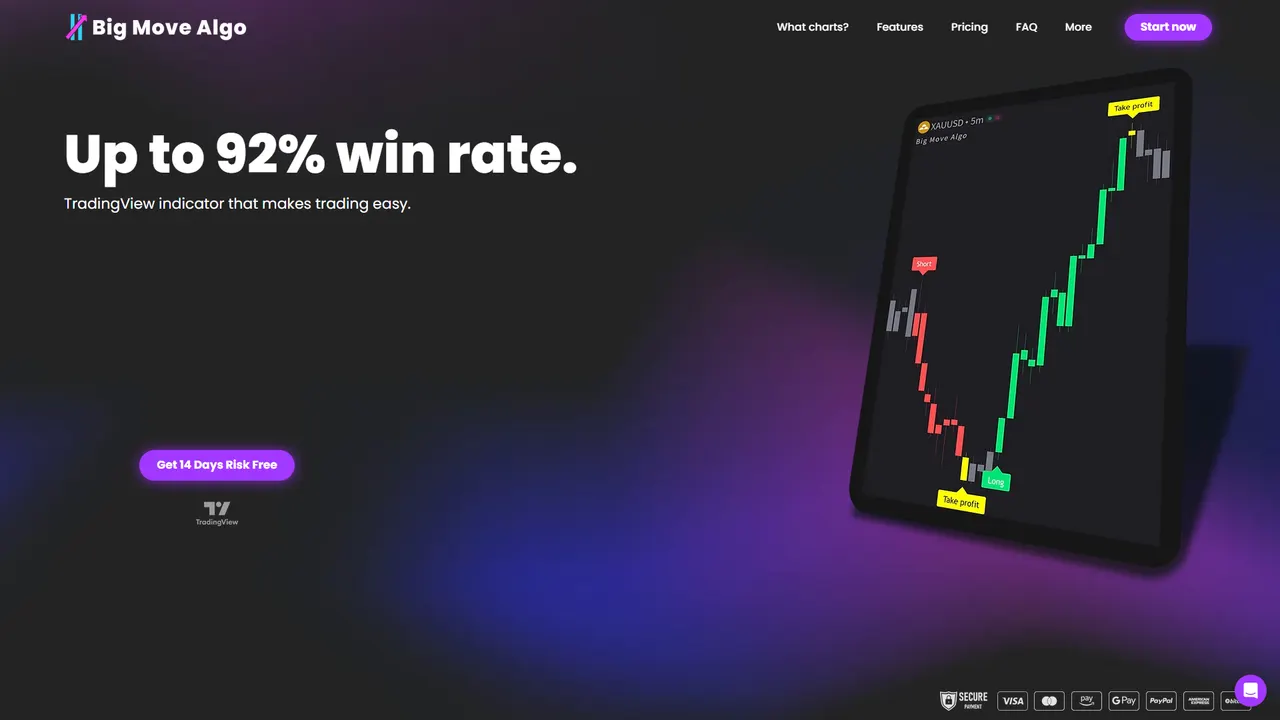
Big Move Algo delivers up to 92% win rate signals directly inside TradingView, covering crypto, forex, stocks, indices, and commodities. The signals are clear and direct: Long, Short, or Exit. No interpretation required. The built-in Fake Trend Detector filters out weak market conditions before a signal fires, so you are only seeing setups worth taking. AUTO Mode gets you running in minutes with minimal setup, while Manual Mode gives experienced traders full customization control. If you want to see exactly how to integrate these signals into your workflow, the step-by-step setup guide walks through the entire process from installation to first live trade.
FAQ
What are automated trade signals?
Automated trade signals are algorithm-generated alerts that identify buy, sell, or exit opportunities in financial markets based on predefined technical conditions. They fire in real time without requiring manual chart analysis from the trader.
How do trade signals reduce emotional trading?
Signals enforce predefined entry, exit, and risk rules on every trade, removing the hesitation and impulsive decisions that cause most trading losses. Because the conditions are set algorithmically, fear and greed cannot override the execution logic.
Can beginners benefit from automated signal systems?
Beginners benefit significantly because signals show exactly which conditions triggered a trade, teaching market structure and risk management through live examples. They reduce the learning curve by turning abstract theory into structured, real-time decisions.
Are automated trade signals guaranteed to be profitable?
No signal system guarantees profits. Signals are decision-support tools that improve consistency and discipline, but they must be paired with sound risk management and an understanding of market context to be effective long-term.
What markets do automated trade signals cover?
Quality signal systems cover multiple asset classes including forex, crypto, equities, commodities, and indices. Big Move Algo, for example, operates across all five of these markets within the TradingView platform.