
How to Get Clear Long Short Trading Signals


Clear long and short trading signals are generated when multiple independent market indicators align to form a high-conviction trade setup with defined entry and exit criteria. Most traders struggle not because markets are too complex, but because they treat single indicators as complete signals. Getting clear long short trading signals requires a composite approach that layers technical, volume, and macro context into one structured decision. This article breaks down exactly what that process looks like, from the tools you need to the execution steps that separate profitable traders from the rest.
How to get clear long short trading signals: tools and prerequisites
Before any signal fires, you need the right infrastructure in place. Trying to generate reliable long and short signals without the correct inputs is like reading a map with half the legend missing.
The core technical tools that support high-quality signal generation include:
Volume profile and relative volume (RVOL): Breakout signals require RVOL of 1.5x or higher to confirm institutional participation. Without this filter, breakout entries frequently fail because retail volume alone cannot sustain a move.
Z-score for mean reversion: A Z-score below -2 identifies price extremes where mean reversion entries carry a statistical edge. This is the quantitative equivalent of buying when something is genuinely oversold, not just lower than yesterday.
Trend filters: Moving averages, ADX, or regime classifiers tell you whether the market is trending or ranging. Applying a breakout strategy in a ranging market destroys your edge before you even enter.
Macro and session filters: Time-of-day filters, economic calendar blocks, and volatility regime checks prevent you from trading into news events or low-liquidity windows where signals degrade fast.
Beyond individual indicators, you need a platform that aggregates these inputs. TradingView supports custom indicators that combine volume, momentum, and trend data into composite outputs. Platforms offering composite signal scoring and alert conditions give you a structured output rather than a pile of raw data to interpret manually.
Here is a quick comparison of signal input types and their primary function:
Input Type | Primary Function | Example Tool/Method |
Volume profile | Confirms institutional participation | RVOL at 1.5x or higher |
Z-score | Identifies mean reversion entry zones | Z-score below -2 |
Trend filter | Classifies market regime | ADX, moving average slope |
Macro filter | Blocks low-quality trading windows | Economic calendar, VIX threshold |
Composite scorer | Combines all inputs into one signal | Custom TradingView indicator |

How professional-grade composite signals are generated
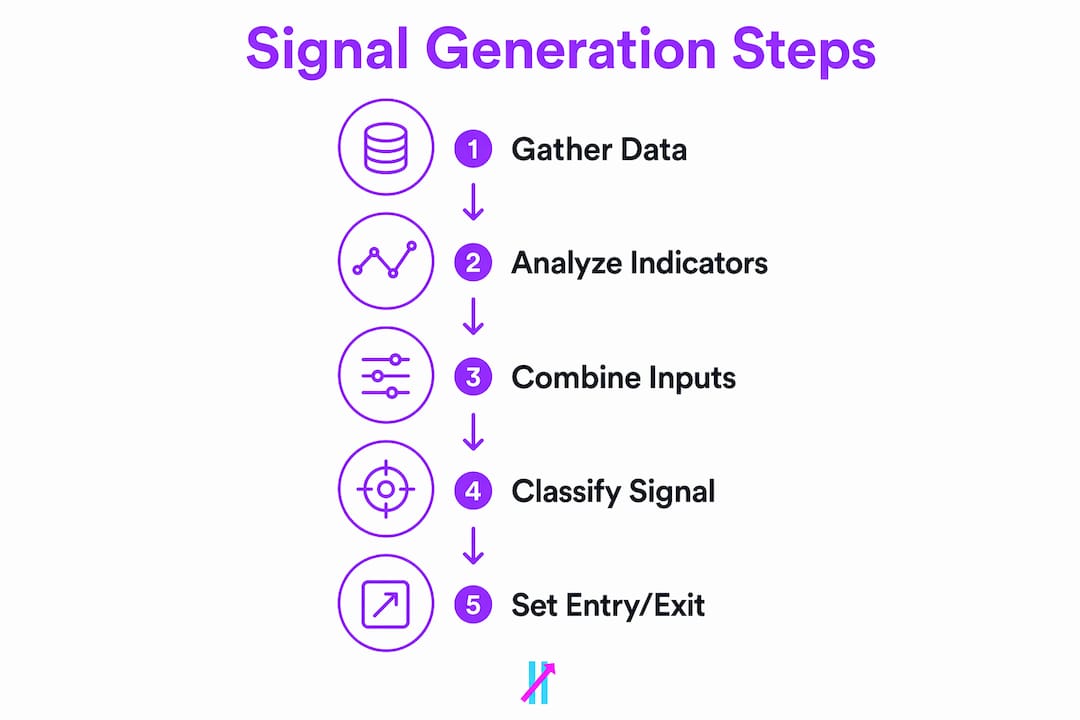
Professional signal systems do not fire on a single condition. Signals only fire when multiple uncorrelated market lenses align, producing fewer but higher-quality setups. This is called a quality gate process, and it is the single biggest difference between amateur and professional signal logic.
Here is how a composite long or short signal is built step by step:
Score each input independently. Technical confluence, volume confirmation, and macro context each receive a sub-score. No single factor dominates the output.
Combine into a composite conviction score. Professional-grade signals use conviction scores on a 0 to 100 scale. A score above 75 is the standard high-conviction threshold before a signal is considered valid.
Apply veto logic. Professional systems veto trades when macro or liquidity filters are unfavorable, even if the technical score is high. This is the filter most retail traders skip entirely.
Trigger a no-trade regime when conditions are poor. Active traders typically see 2 to 4 qualifying setups per day. When reward-to-risk criteria are not met, no signal fires. Silence is a valid output.
Apply signal cooldowns. After a signal fires, a cooldown period prevents the system from generating a new signal immediately. This stops overtrading during choppy or post-news conditions.
Map stops and targets at entry. Every signal includes a pre-defined stop loss and target level. Stops are typically set 2 ATR away from entry, and timed exits within 5 bars limit losses on stagnant mean reversion trades.
Pro Tip: If your signal system does not include a no-trade output, it is not a complete system. The ability to stay out of the market is as valuable as any long or short entry.
The output of this process is a labeled signal: Long, Short, or no entry. Visual labels for standard and strong entries, mapped stops, trailing exits, and alert conditions are the hallmarks of a complete signal engine.
How to apply long and short signals step-by-step in your strategy
Knowing how signals are built is half the work. Applying them correctly in live trading is where most execution mistakes happen. Follow this sequence to put clear trading signal strategies into practice:
Set your conviction threshold before the session. Decide in advance that you will only act on signals scoring above your chosen threshold. Changing this mid-session based on impatience is one of the most common and costly mistakes.
Confirm signal bias and momentum before entry. Check that the signal direction aligns with the current market regime. A long signal in a confirmed downtrend requires a much higher conviction score to justify entry.
Enter at the mapped price level. Do not chase entries. If the signal fires and price has already moved 1 ATR past the entry level, skip the trade. The edge is priced into the entry, not the direction.
Place your stop immediately at entry. Stops set 2 ATR away from entry give trades room to breathe while capping downside. Adjusting stops after entry based on hope rather than price action is a discipline failure, not a strategy.
Use trailing exits for strong signals. When a trade moves in your favor past the first target, trail the stop to lock in gains. Composite signal engines that include trailing exit logic remove the emotional component from this decision entirely.
“The goal is not to be right on every trade. The goal is to take every high-conviction setup correctly and let the probabilities work over time.”
Integrating signals with discretionary context means you check one additional layer before entry: is there an obvious reason this signal might fail today? A major earnings release, a central bank announcement, or an abnormal gap open are all valid reasons to skip even a high-scoring signal.
What are the best long/short risk management practices?
Risk management in long/short trading is not just about stop losses. It is about controlling your net exposure to the market at all times.
Effective long/short risk management keeps net market exposure between 20% and 40% during stable periods. Net exposure is the difference between your long positions and your short positions as a percentage of total capital. Staying within this range means a sudden market move in either direction does not wipe out your account before you can react.
The critical risk factor most traders underestimate is correlation. When volatility spikes above 30%, correlations between assets spike above 0.8, which means your long and short positions start moving together instead of offsetting each other. Your hedge stops working exactly when you need it most. Long/short equity managers adjust net exposure tactically from 20% to 80% in response to these regime shifts, not on a fixed schedule.
Pro Tip: During high-volatility periods, reduce position size across all signals rather than trying to pick which signals will survive the correlation spike. Smaller size across the board beats selective guessing every time.
Here is a comparison of exposure approaches by market condition:
Market Condition | Recommended Net Exposure | Adjustment Action |
Stable, low volatility | 20% to 40% | Maintain standard position sizing |
Rising volatility (VIX above 25) | 10% to 20% | Reduce size, tighten stops |
Volatility spike (VIX above 30) | Below 10% | Shift to market-neutral or cash |
Trending market | Up to 60% directional | Increase long or short bias accordingly |
For pair trades specifically, success depends on highly correlated assets to profit from relative price spread rather than absolute direction. Pairing two assets with low historical correlation turns a hedged trade into two separate directional bets, which defeats the purpose entirely.
Common mistakes that degrade signal quality
Even with the right tools and process, traders consistently make the same errors that reduce signal effectiveness. Recognizing these patterns is the fastest way to improve your results.
Treating a single indicator as a complete signal. A moving average crossover is an input, not a signal. Retail traders often mistake single indicators for complete trading signals. Professional systems require multiple independent confirmations before any entry is valid.
Overtrading during low-conviction regimes. When the composite score is below your threshold, the correct action is no trade. Forcing entries during choppy or low-volume conditions produces losses that erase gains from your best setups.
Ignoring filters and cooldowns. Skipping the macro filter because “the chart looks good” is how traders walk into earnings announcements and news spikes. Cooldowns exist to prevent signal spam after volatile moves.
Overleveraging on poor-quality signals. Position size should scale with conviction score, not with how much you want to make on a trade. A signal scoring 60 out of 100 deserves half the size of a signal scoring 85.
Failing to adapt to changing market conditions. A signal system calibrated for a trending market will generate false signals in a ranging market. Regime awareness is not optional. It is the context that determines whether your edge is active or dormant.
Key takeaways
Clear long and short trading signals require composite confirmation across technical, volume, and macro inputs, with conviction thresholds and veto logic separating high-quality setups from noise.
Point | Details |
Composite scoring is non-negotiable | Signals built on a single indicator fail at scale; use multi-factor conviction scores above 75. |
No-trade is a valid signal output | Silence from a well-built system protects capital better than a forced low-conviction entry. |
Net exposure controls survival | Keep net market exposure between 20% and 40% during stable periods and adjust dynamically during volatility spikes. |
Correlation breaks hedges | When volatility exceeds 30%, asset correlations spike above 0.8 and long/short hedges lose effectiveness. |
Execution discipline drives results | Correct entry sizing, pre-set stops, and trailing exits matter more than signal frequency. |
Why most traders overcomplicate what signals are actually telling them
After years of watching traders work through signal systems, the pattern I see most often is this: traders collect more indicators instead of building better filters. They add a fourth or fifth input hoping it will solve the problem that the first three inputs already identified. It does not. More data without a quality gate process just produces more noise.
The traders who consistently extract value from long and short signals share one habit. They define what a valid signal looks like before the session starts, and they do not negotiate with themselves during it. A composite score below threshold means no trade, full stop. This sounds simple, and it is. But executing it under live market conditions, when a setup looks compelling and your conviction score reads 68, requires a level of discipline that most traders underestimate until they have blown up an account ignoring it.
I have also found that algo trading frameworks that automate the signal-to-execution step remove the single biggest variable in trading performance: the trader’s mood. When the system decides what qualifies as a signal and places the trade automatically, you stop second-guessing entries and start focusing on system improvement instead.
The best long short signals are not the ones that fire most often. They are the ones that fire only when every filter agrees. Fewer trades, higher quality, better outcomes over time.
— Steven Hartwell
How Big Move Algo delivers high-conviction signals without the complexity
Big Move Algo is a TradingView indicator built specifically to give traders clear, structured long and short signals without requiring advanced technical knowledge or hours of chart analysis.

The platform generates composite conviction signals labeled Long, Short, and Exit, with mapped stops and targets built into every alert. The built-in Fake Trend Detector filters out low-quality market conditions automatically, so you are not trading into noise. AUTO Mode gets you running in minutes, while Manual Mode gives experienced traders additional control over signal parameters. Big Move Algo works across crypto, forex, stocks, indices, and commodities. If you are ready to trade with structure instead of guesswork, explore Big Move Algo and see the signal system in action.
FAQ
What does a clear long or short trading signal include?
A complete trading signal includes a directional label (Long or Short), a defined entry price, a stop loss level, and a target. Signals without mapped stops and targets are incomplete and require manual risk decisions at the worst possible moment.
How many signals should a quality system generate per day?
Active traders typically see 2 to 4 qualifying setups per day from a well-filtered composite system. Platforms that generate dozens of signals daily are almost always skipping conviction thresholds and quality gate filters.
What is a conviction score in trading signals?
A conviction score is a composite rating on a 0 to 100 scale that measures how strongly multiple independent indicators agree on a trade setup. Scores above 75 are the standard threshold for high-conviction entries worth acting on.
Why do long/short hedges sometimes fail during volatile markets?
When market volatility exceeds 30%, correlations between assets spike above 0.8, meaning long and short positions move in the same direction instead of offsetting each other. This is a structural reality of long/short strategies, not a system failure.
Can beginners use composite signal systems effectively?
Yes. Platforms like Big Move Algo are designed so that beginners can use AUTO Mode to receive pre-filtered signals without configuring individual indicators. The platform usage guide walks through the setup process step by step.
Recommended
Comments