
How Automated Trading Generates Income for Traders
- Steven Hartwell

- Jun 26
- 8 min read

Automated trading generates income by using computer programs to execute predefined trading rules faster and more consistently than any human trader can. The industry term for this is algorithmic trading, and platforms like MetaTrader, NinjaTrader, and Big Move Algo all operate on the same core principle: a strategy with a proven edge, executed without hesitation or emotion. Understanding how automated trading generates income means understanding two things first. The system is only as good as the strategy it runs. And the income is real, but it is not effortless.
How automated trading generates income: strategy and execution
Automated trading generates income through a simple but demanding process: a computer program follows a set of predefined rules and places trades whenever those rules are met. The program does not hesitate, second-guess, or panic. According to Investopedia, automated systems improve efficiency and reduce emotional impact by executing strategies faster and more systematically than manual trading.
Profitability, though, does not come from the automation itself. It comes from the underlying strategy. Positive expectancy is the most important metric in any trading system. Expectancy combines your win rate, your average winning trade, and your average losing trade into a single number. A positive expectancy means the system makes money over time. A negative one means automation just loses money faster.
The formula matters because automation multiplies whatever edge you have. A strategy with a genuine edge, run consistently across hundreds of trades, compounds that advantage. A flawed strategy, automated, compounds the losses just as efficiently.

Backtesting is the process of running your strategy against historical price data to measure its expectancy before risking real capital. Backtested edge is mandatory before automating any system. Without it, you are running blind.
Pro Tip: When backtesting, use conservative assumptions for slippage and commissions. Real-world fills are almost always worse than ideal conditions, and small frequent trades are especially vulnerable to execution costs eating into net returns.
The key points to verify in any backtest:
Win rate: What percentage of trades close profitably?
Average win vs. average loss: Does the system win more per trade than it loses?
Maximum drawdown: How far did the account drop before recovering?
Trade frequency: How many trades does the system generate per week or month?
A system that wins 40% of the time can still be highly profitable if the average win is three times the average loss. Win rate alone tells you nothing without the full expectancy picture.
What income models do automated trading strategies use?
Automated systems generate income through several distinct models. Each captures profit from a different type of market behavior. Understanding the differences helps traders choose the right approach for their capital, time horizon, and risk tolerance.
Strategy | How it generates income | Key risk |
Arbitrage | Captures price differences for the same asset across markets or instruments | Requires speed; windows close in milliseconds |
Market making | Profits from the bid-ask spread by continuously quoting both sides | Inventory risk if price moves sharply in one direction |
Trend following | Buys into rising trends, sells into falling ones | Whipsaws in choppy, sideways markets |
Grid trading | Places buy and sell orders at fixed intervals above and below price | Fails in strong trending markets without a stop mechanism |
Momentum | Enters trades when price accelerates in a direction | High sensitivity to sudden reversals |
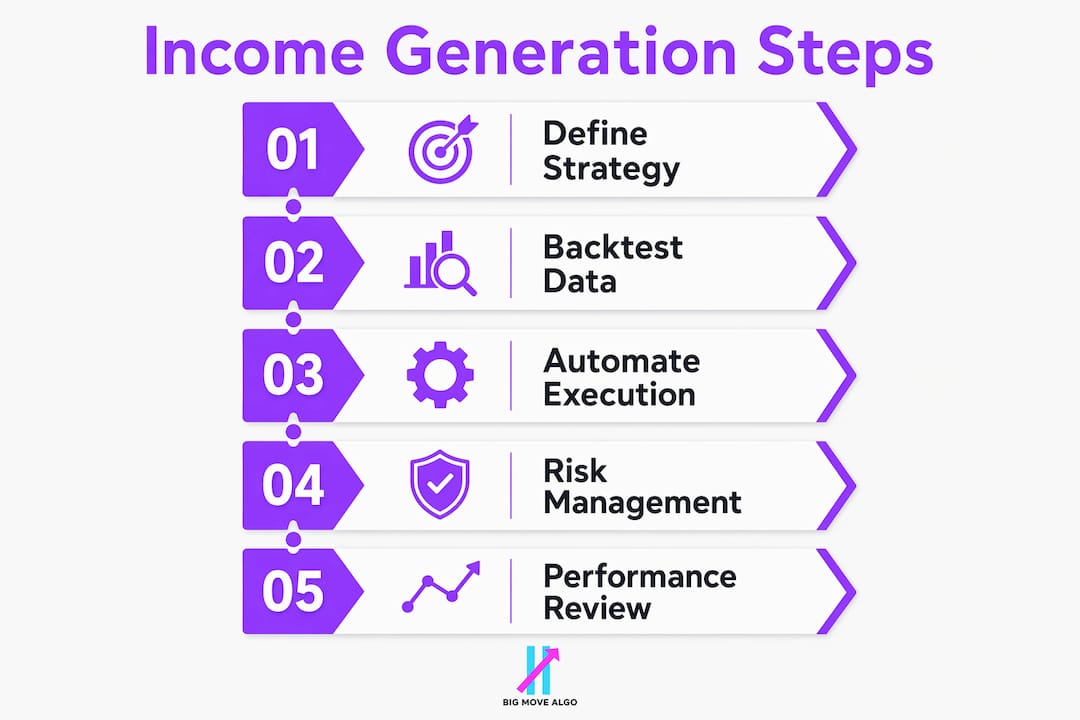
Arbitrage and market-making models are the foundation of institutional algorithmic trading. They profit from repeatable small gains extracted from systematic market inefficiencies. Retail traders rarely have the infrastructure for pure arbitrage, but trend following and grid trading are accessible on platforms like TradingView, MetaTrader, and Big Move Algo.
Trend following is the most widely used approach among retail algorithmic traders. The logic is direct: when price moves in a sustained direction, the system enters in that direction and holds until the trend breaks. Income from algorithm trading via trend following comes from capturing the middle portion of large moves, not from predicting tops or bottoms.
Grid trading works differently. It places a series of buy orders below the current price and sell orders above it. Each time price moves through a grid level, a trade closes for a small profit. The system generates income from volatility itself, regardless of direction. The risk is a strong directional move that pushes price outside the grid range entirely.
What operational realities affect income from automated systems?
Automation is not a set-and-forget income machine. Algorithms can underperform in volatile or changed market regimes and require continuous oversight. Markets shift. A strategy that worked well in a trending environment may bleed capital in a choppy one. Recognizing that shift early is what separates traders who survive from those who do not.
The operational realities every trader must manage:
Daily system checks: Verify the system is running, connected to the data feed, and placing trades as expected. A disconnected platform or a broker outage can cause missed trades or unintended open positions.
Performance monitoring: Compare live results against backtest benchmarks weekly. A significant gap signals either a market regime change or a system error.
Drawdown limits: Set a maximum drawdown threshold before the system is paused. This is the kill-switch. If the account drops beyond a defined level, the system stops trading until you review it manually.
Position sizing: Risk a fixed percentage of capital per trade, not a fixed dollar amount. This keeps losses proportional as the account grows or shrinks.
Regime awareness: Identify whether the current market is trending, ranging, or unusually volatile. Some systems should be switched off during certain conditions entirely.
Successful systems require regular performance reviews and occasional tuning. The daily time commitment is typically 5–15 minutes, not hours. That is genuinely low compared to manual trading, but it is not zero.
Pro Tip: Set calendar reminders for weekly strategy reviews. Traders who check performance only when something feels wrong are always reacting too late. Consistent, scheduled reviews catch problems before they become expensive.
The myth of completely passive income from trading bots is worth addressing directly. Risk management is the priority over maximizing per-trade profits. Firms and experienced retail traders scale only after stability is confirmed. The income is real. The passivity is partial.
How to implement automated trading to generate income
Getting started with automated trading requires four things: a reliable platform, a backtested strategy, appropriate starting capital, and a clear risk management plan. Skipping any of these produces predictable results.
Choose a platform with a proven track record. TradingView, MetaTrader 4/5, and NinjaTrader are the most widely used platforms for retail algorithmic trading. Big Move Algo operates as a TradingView indicator, delivering Long, Short, and Exit signals in real time across crypto, forex, stocks, indices, and commodities.
Start with a strategy that has documented positive expectancy. Either build and backtest your own rules or use a signal-based tool like Big Move Algo, which provides structured signals designed to reduce the guesswork in entry and exit decisions. Learn more about automated trading for retail traders to understand how signal-based systems fit into a broader income strategy.
Size your starting capital to your risk tolerance. A common rule is to risk no more than 1–2% of total capital on any single trade. This means a $5,000 account risks $50–$100 per trade. Small enough to survive a losing streak, large enough to compound meaningful returns.
Commit to minimal but consistent oversight. The practical usage of automation does not demand hours of screen time. It demands discipline: check the system daily, review performance weekly, and adjust only when the data supports it.
Avoid the common pitfalls. Overfitting a backtest to historical data produces strategies that look perfect on paper and fail in live markets. Execution costs like slippage can wipe out small frequent profits entirely if not accounted for in the backtest.
The benefits of automated trade signals go beyond speed. They remove the emotional decision-making that causes most retail traders to exit winning trades too early and hold losing trades too long.
Key Takeaways
Automated trading generates income only when a system with positive expectancy is executed consistently, managed with strict risk controls, and reviewed regularly as market conditions change.
Point | Details |
Expectancy drives income | A strategy must have positive expectancy before automation adds any value. |
Automation enforces consistency | Systems remove emotional errors but cannot fix a losing strategy. |
Risk controls determine survival | Drawdown limits and position sizing protect capital during losing streaks. |
Daily oversight is minimal but required | Successful systems need 5–15 minutes of daily checks, not hours. |
Execution costs matter | Slippage and commissions must be factored into backtests to avoid false results. |
Automation amplifies what you bring to it
I have watched traders approach automated systems with two completely different mindsets. The first group treats automation as a shortcut. They buy a bot, connect it to a broker, and expect income to appear. The second group treats automation as a tool that enforces their discipline. The second group is the one still trading two years later.
The uncomfortable truth is that automated trading amplifies the quality of your strategy, not the size of your ambition. A well-researched system with a genuine edge becomes more powerful when automated because it executes without hesitation across every valid signal. A poorly researched system becomes more dangerous for exactly the same reason.
Markets also change. A strategy that generated consistent income in a trending 2024 environment may struggle in a choppy 2026 market. The traders who adapt their systems to current conditions are the ones who sustain income over time. Those who set and forget eventually face a drawdown they did not plan for.
What I find genuinely useful about tools like Big Move Algo is the Fake Trend Detector feature. It filters out low-quality market conditions where trading is not recommended. That kind of built-in regime awareness is exactly what most retail traders lack when they try to build systems from scratch. It does not guarantee profits, but it reduces the number of bad trades the system takes in the first place.
Realistic expectations matter more than any single tool. Automated trading is not a replacement for understanding markets. It is a way to execute your understanding more consistently than you could by hand.
— Steven Hartwell
Big Move Algo: signals built for systematic income
Traders who want to generate profits with robots but lack the time to build and backtest strategies from scratch have a direct path forward with Big Move Algo.
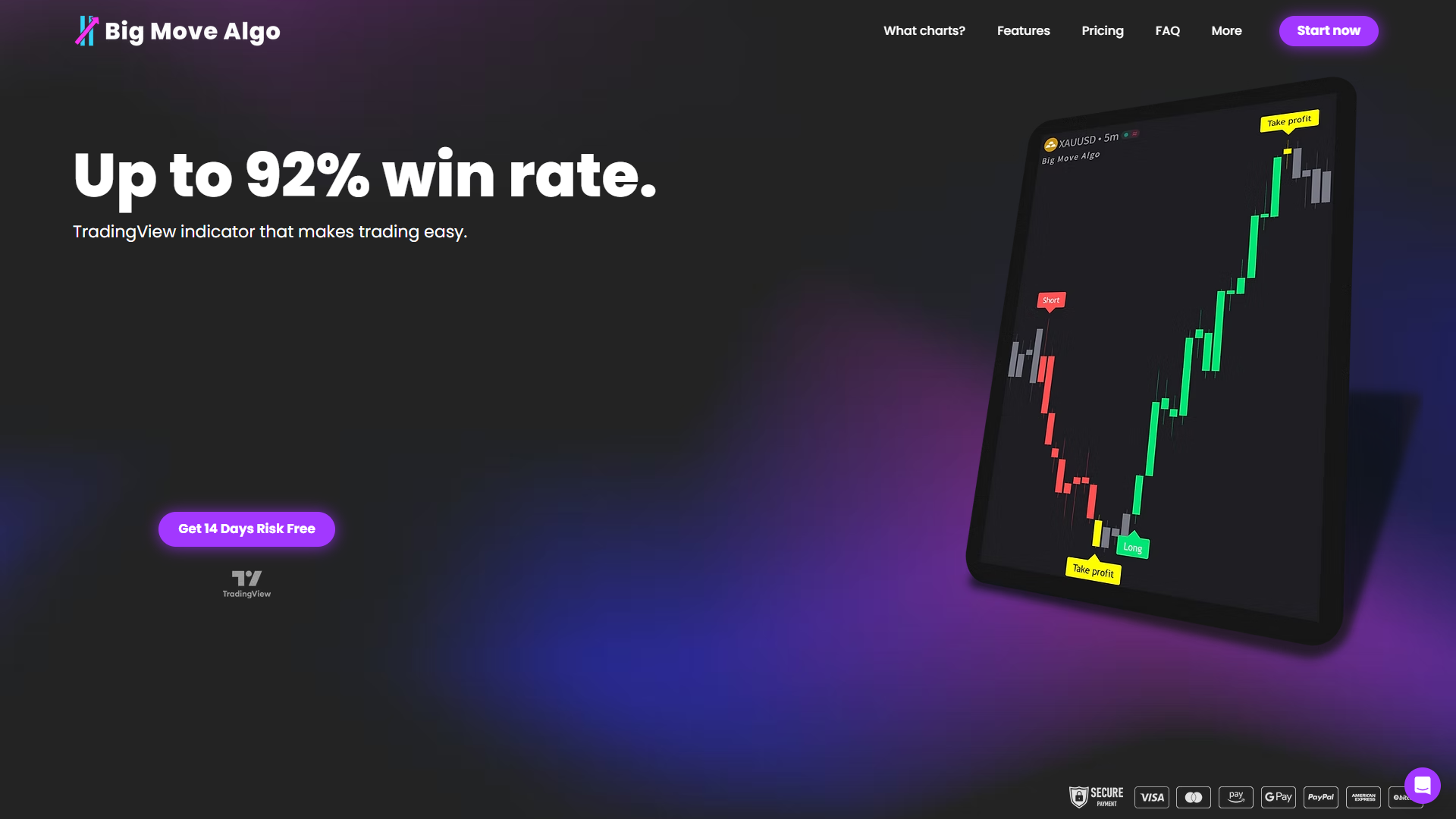
Big Move Algo is a TradingView indicator that delivers real-time Long, Short, and Exit signals across crypto, forex, stocks, indices, and commodities. The platform claims up to a 92% win rate and is built for traders who want structured decisions without the complexity of advanced programming. AUTO Mode gets you running with minimal setup. The built-in Fake Trend Detector filters out poor market conditions automatically. Visit Big Move Algo to see the full signal performance, or check the installation guide to get started quickly.
FAQ
What is the core mechanism behind automated trading income?
Automated trading generates income by executing a predefined strategy with speed and consistency that removes emotional errors. The income depends entirely on the strategy having positive expectancy over a large sample of trades.
Can trading bots make money without constant monitoring?
Trading bots can generate income with minimal oversight, typically 5–15 minutes of daily checks, but they are not fully passive. Market regime changes and system errors require regular review to avoid unexpected losses.
What is expectancy and why does it matter?
Expectancy is the average profit per trade after accounting for both wins and losses. A positive expectancy means the system is profitable over time; a negative one means losses accumulate regardless of how well the system executes.
What are the biggest risks in automated trading?
The main risks are overfitted backtests that fail in live markets, execution costs like slippage reducing net returns, and market regime shifts that make a previously profitable strategy unprofitable. Drawdown limits and kill-switches are the primary defenses.
How do I start generating income from algorithm trading?
Start by selecting a platform like TradingView or MetaTrader, then either build a backtested strategy or use a signal tool like Big Move Algo. Risk no more than 1–2% of capital per trade and review performance weekly before scaling up.
Recommended
Comments