
Swing Trading Explained: A Beginner's Guide for 2026
- Steven Hartwell

- Jun 24
- 8 min read

Swing trading is defined as a speculative strategy that captures short- to intermediate-term price moves by holding positions from a few days to several weeks. Unlike day trading, swing trading does not require you to watch charts every minute. Unlike buy-and-hold investing, it does not ask you to wait years for a return. Resources like Investopedia, NerdWallet, and Big Move Algo all point to the same core idea: swing trading sits in the middle ground, using technical analysis and market psychology to profit from natural price swings.
What is swing trading and how does it differ from other styles?
Swing trading is a rules-based approach to profiting from price movement between identifiable support and resistance levels. The holding period is the single biggest practical difference between swing trading and other styles. Day traders close every position before the market closes. Long-term investors hold for months or years. Swing traders sit between those two extremes, holding for days to weeks and targeting specific price moves within a broader trend.
The table below shows how the three styles compare across the factors that matter most to new traders.
Factor | Swing trading | Day trading | Long-term investing |
Holding period | Days to weeks | Minutes to hours | Months to years |
Trades per week | Low to moderate | High | Very low |
Time required daily | 1–3 hours | Full day | Minimal |
Primary tool | Technical analysis | Technical analysis | Fundamental analysis |
Overnight risk | Yes | No | Yes |
Swing trading requires roughly 1–3 hours of daily analysis. That makes it realistic for traders who have jobs or other commitments. Day trading demands full-time attention and generates far more transaction costs. Long-term investing demands patience most beginners struggle to maintain when prices drop sharply.

One key distinction is overnight risk. Because swing traders hold positions overnight, they are exposed to price gaps caused by earnings reports, economic data, or geopolitical events that occur outside market hours. Day traders avoid this entirely by closing all positions before the session ends. Swing traders must plan for it through stop-loss placement and position sizing.
Swing trading also focuses on capturing swings rather than calling perfect tops or bottoms. That distinction matters. Most beginners try to buy the exact low and sell the exact high. Swing trading abandons that goal and instead targets a disciplined slice of a move, which is far more repeatable.
What swing trading strategies and technical tools actually work?
Swing trading strategies rely on technical analysis to identify high-probability entry and exit points. The goal is never to predict the market. The goal is to find conditions where the odds favor a move in one direction, then act with a defined risk.
The most widely used technical tools in swing trading include:
Support and resistance zones. Price tends to react at levels where buyers and sellers have historically clashed. Identifying these zones gives swing traders a map of where to look for entries and exits.
Moving averages. The 20-period and 50-period moving averages are common reference points. Price bouncing off a rising 50-period moving average on a daily chart is a classic swing trade setup.
RSI (Relative Strength Index). RSI measures momentum on a scale of 0 to 100. Readings below 30 suggest oversold conditions. Readings above 70 suggest overbought conditions. Swing traders use these extremes to time entries against the crowd.
Stochastic oscillator. Like RSI, the Stochastic oscillator identifies momentum shifts. It works well in ranging markets where RSI can give mixed signals.
Candlestick patterns. Patterns like the engulfing candle, pin bar, and inside bar signal potential reversals or continuations. They work best when they appear at key support or resistance levels.
Volume confirmation. A price move supported by above-average volume carries more weight than one on thin volume. Volume confirms that real buying or selling pressure is behind the move.
The real edge in swing trading comes from combining multiple confirming factors rather than relying on any single indicator. A support level alone is not a trade. A support level plus an RSI reading below 30 plus a bullish engulfing candle on above-average volume is a trade worth considering. That combination is called confluence.
Pro Tip: Never trade based on one indicator alone. Wait for at least two or three signals to align at the same price level before entering a position. Confluence filters out the majority of false signals.
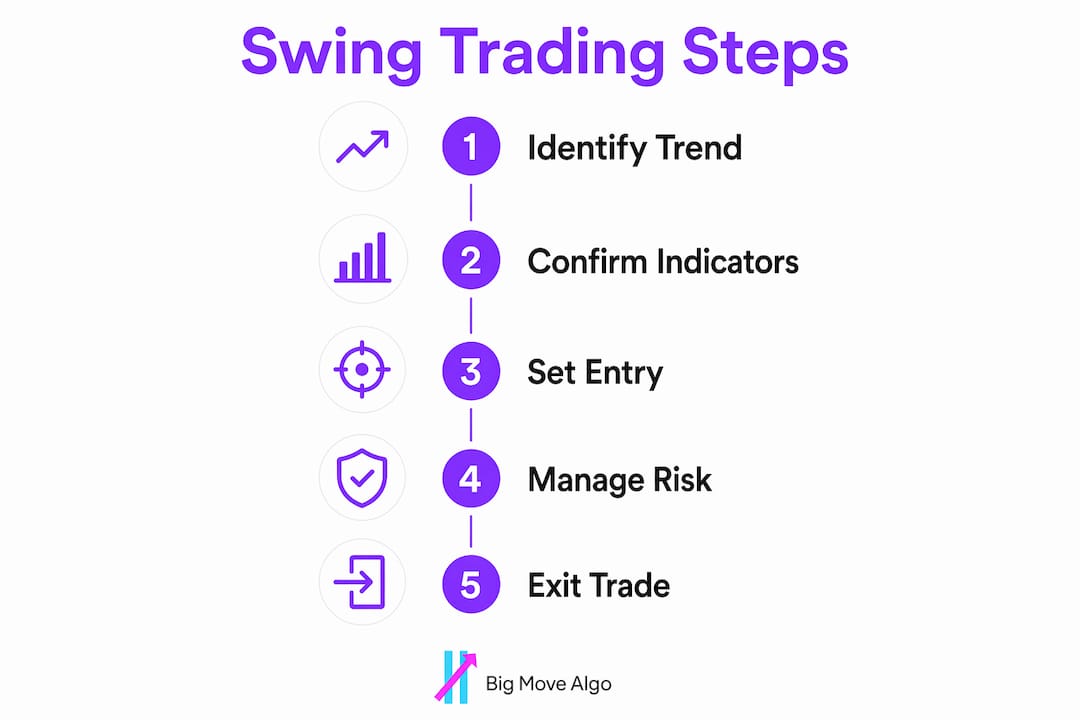
Multi-timeframe analysis is another technique many beginners skip. Aligning multiple timeframes means checking the weekly or daily chart to confirm the broader trend, then dropping to the 4-hour or 1-hour chart to time the entry. Trading in the direction of the higher timeframe trend dramatically improves the odds of a successful swing.
How does risk management protect your capital in swing trading?
Risk management determines whether a swing trader survives long enough to become profitable. Entry signals get most of the attention, but position sizing and stop-loss discipline determine profitability more than entry accuracy.
The standard framework for managing risk in swing trading includes:
The 1%–2% rule. Risk no more than 1%–2% of your total trading capital on any single trade. On a $10,000 account, that means risking $100–$200 per trade. This rule keeps a losing streak from wiping out your account.
Stop-loss orders. Place a stop-loss at a level that invalidates your trade thesis. If you buy at a support zone, your stop goes just below that zone. The stop is not a guess. It is a logical price where the setup no longer makes sense.
Position sizing. Calculate your position size based on the distance between your entry and your stop-loss, not on how confident you feel. Confidence is not a risk management tool.
Risk/reward ratio. Target a minimum 1:2 risk/reward ratio. If you risk $100, your target should be at least $200. This means you can be wrong more than half the time and still make money.
Overnight gap planning. Because swing traders hold positions overnight, stops must be wide enough to survive normal overnight volatility without being wide enough to cause excessive losses if a gap occurs.
Pro Tip: Set your exit target before you enter the trade. Traders who decide their target after entering almost always move it further away when price gets close, turning a winning trade into a losing one.
Emotional trading is the most common reason new traders blow up accounts. A clear plan with defined entries, stops, and targets removes most of the decisions that emotion corrupts. The plan runs the trade. You execute the plan.
How to swing trade: a practical workflow for beginners
Starting swing trading does not require a complex setup. It requires a repeatable process applied consistently. Typical swing trading targets 2%–5% profit per trade with win rates around 45%–55%, which means losses are a normal part of the process.
A practical daily workflow for new swing traders looks like this:
Step 1: Check the higher timeframe trend. Before looking at any trade, determine whether the daily or weekly chart is in an uptrend, downtrend, or range. Only take trades aligned with that direction.
Step 2: Build a watchlist. Identify 5–10 assets showing clear setups near key support or resistance levels. Stocks, forex pairs, crypto, and indices all work for swing trading.
Step 3: Wait for confluence. Do not force trades. Wait for your technical criteria to align: price at a key level, momentum indicator confirming, and volume supporting the move.
Step 4: Define the trade plan. Before entering, write down your entry price, stop-loss level, and profit target. No plan means no trade.
Step 5: Execute and monitor. Enter the trade, set your stop and target orders, and check in once or twice per day. Swing trading does not require constant monitoring.
Step 6: Review and journal. After each trade closes, record what happened and why. Reviewing your trading platform checklist and your trade journal regularly is how you improve faster than most traders.
Technology helps this process significantly. Big Move Algo is a TradingView indicator that delivers clear Long, Short, and Exit signals across stocks, crypto, forex, indices, and commodities. Its built-in Fake Trend Detector filters out low-quality market conditions, which is exactly the kind of filter new traders need when learning how swing trade setups work. The AUTO Mode requires minimal setup, so beginners can get started without spending weeks configuring a system. Learning about automated trade signals can also help you understand how tools like this fit into a structured swing trading workflow.
Key takeaways
Swing trading works because it combines disciplined technical analysis, defined risk management, and realistic profit targets to capture repeatable price moves over days to weeks.
Point | Details |
Definition | Swing trading holds positions for days to weeks to capture short- to intermediate-term price moves. |
Core tools | RSI, moving averages, support/resistance, and volume confirmation improve entry and exit timing. |
Risk management | The 1%–2% rule and stop-loss orders protect capital across a long series of trades. |
Overnight risk | Positions held overnight require wider stops and careful sizing to account for gap events. |
Workflow | Analyze the higher timeframe trend first, then use lower timeframes to time entries precisely. |
Why patience is the real edge in swing trading
Swing trading rewards patience more than intelligence. I have watched traders with advanced charting setups and deep market knowledge blow up accounts because they could not sit on their hands and wait for a clean setup. The market does not owe you a trade every day.
The biggest mistake I see new traders make is treating every price move as an opportunity. Swing trading is about selectivity. The best setups are obvious. They show up at clear levels with multiple confirming signals. If you are squinting at a chart trying to convince yourself a setup is valid, it is not valid.
The second mistake is ignoring the higher timeframe. A trader who sees a bullish RSI signal on a 1-hour chart but ignores a clear downtrend on the daily chart is fighting the market. The higher timeframe always wins eventually. Aligning your trades with the dominant trend is not optional. It is the foundation of how swing trade setups actually work in practice.
Swing trading is also more forgiving than day trading for beginners. You have hours, not seconds, to make decisions. That time advantage is worth more than any indicator. Use it to think clearly, check your plan, and avoid reactive decisions. The traders who scale their accounts consistently are not the ones with the best entries. They are the ones who cut losses quickly and let winners run without interference.
— Steven Hartwell
How Big Move Algo fits into your swing trading approach
Knowing the theory behind swing trading is one thing. Executing it consistently under real market conditions is another challenge entirely.
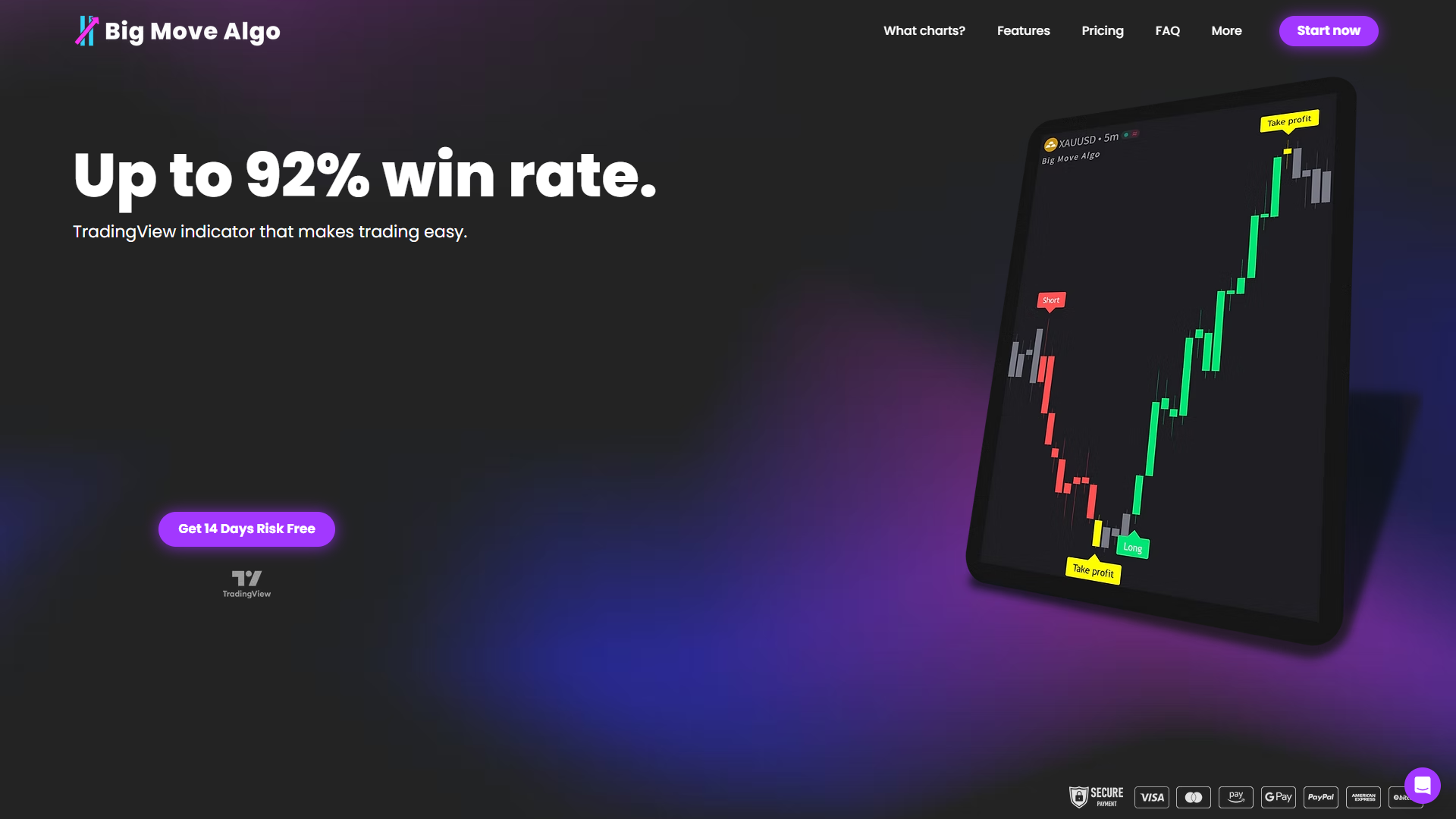
Big Move Algo is built for traders who want clear, structured signals without spending hours analyzing charts. The indicator runs directly on TradingView and delivers Long, Short, and Exit signals across crypto, forex, stocks, indices, and commodities. The Fake Trend Detector filters out conditions where the market is not worth trading, which protects new traders from the low-quality setups that cause most early losses. You can get started with Big Move Algo’s trading signals immediately after subscribing, with AUTO Mode handling the setup so you can focus on execution. If you want to see exactly how the tool works in practice, the step-by-step usage guide walks you through every feature.
FAQ
What is swing trading in simple terms?
Swing trading is a style where you hold a stock, currency, or other asset for a few days to several weeks to profit from a specific price move. It uses technical analysis to time entries and exits rather than predicting long-term market direction.
How is swing trading different from day trading?
Day traders open and close all positions within a single trading session. Swing traders hold positions overnight and across multiple sessions, which means fewer trades but larger profit targets per trade.
What technical indicators do swing traders use most?
Swing traders most commonly use RSI, moving averages, Stochastic oscillators, support and resistance zones, and volume confirmation. The strongest setups combine several of these signals at the same price level.
How much capital do I need to start swing trading?
A commonly cited minimum is $5,000, though the exact amount depends on the market and broker. The more important factor is applying the 1%–2% risk rule consistently regardless of account size.
Can beginners learn swing trading without experience?
Yes, but a structured approach is required. Starting with a clear watchlist, a defined trade plan, and a journaling habit builds the discipline that separates consistent traders from those who quit after early losses.
Recommended
Comments