
Trading Terms Beginners Should Know in 2026


Trading terminology is the foundation every new retail trader must master before placing a single order. Without a working vocabulary, charts and price feeds become noise. The trading terms beginners should know span order types, price mechanics, leverage, and risk management. Each concept connects directly to real money decisions. This guide defines each term clearly, explains why it matters, and shows you how it applies in live markets.
1. What are basic order types every beginner must understand?
Order types are the commands you send to a market to buy or sell an asset. Getting them wrong costs money. Getting them right gives you control over entries, exits, and risk.
Market order executes immediately at the best available price. Use it when speed matters more than price precision, such as entering a fast-moving breakout.

Limit order executes only at a price you specify or better. If a stock trades at $50 and you set a buy limit at $48, the order fills only if the price drops to $48. This gives you price control but no guarantee of execution.
Stop-loss order closes your trade automatically when price hits a level you set in advance. Stop-loss orders are a core risk management tool that protects your capital from runaway losses. Every trade you open should have one.
Take-profit order closes your trade automatically when price reaches your target gain. Pairing a stop-loss with a take-profit removes the emotional temptation to hold too long or exit too early.
Pro Tip: Never enter a trade without setting both a stop-loss and a take-profit at the same time. Skipping either one turns a planned trade into a gamble.
2. How does leverage and margin affect your risk?
Leverage lets you control a position larger than your actual account balance. It is one of the most misunderstood concepts in basic trading concepts for beginners.
1:100 leverage means $100 in your account controls a $10,000 position. At 1:500, that same $100 controls $50,000. That scale shows exactly why leverage is powerful and dangerous at the same time.
Margin is the portion of your own capital required to open and hold a leveraged position. Think of it as a security deposit. If the market moves against you, your margin gets consumed first.
The critical risk: leverage magnifies losses at the same rate it magnifies gains. A 1% move against a 1:100 leveraged position wipes out your entire margin on that trade. Beginners who use maximum leverage without a stop-loss frequently lose their full account balance within days.
Pro Tip: Start with the lowest leverage your broker offers, typically 1:10 or 1:20, until you have at least 50 consistent demo trades behind you.
3. What key price-related terms should beginners know?
Price mechanics determine your actual cost of trading. Understanding them prevents surprises when your profit looks smaller than expected.
Bid and ask are the two prices you see quoted for every asset. The bid is the highest price a buyer will pay, and the ask is the lowest price a seller will accept. You buy at the ask and sell at the bid.
Spread is the gap between the bid and the ask. If the bid is $99 and the ask is $100, the spread equals $1. That $1 is an immediate cost you absorb the moment you enter a trade. Tighter spreads mean lower trading costs.
Pip is the standard unit of price movement in forex. A pip equals 0.0001, or one ten-thousandth, for most currency pairs. A move from 1.1050 to 1.1060 is 10 pips.
Lot size defines how much of an asset you are buying or selling. In forex, a standard lot is 100,000 units of the base currency. Mini lots (10,000 units) and micro lots (1,000 units) let beginners trade smaller positions with less capital at risk.
Term | Definition | Example |
Bid | Highest price a buyer will pay | $99.00 |
Ask | Lowest price a seller will accept | $100.00 |
Spread | Difference between ask and bid | $1.00 |
Pip | Smallest price move in forex | 0.0001 |
Standard lot | 100,000 units of base currency | 1 lot of EUR/USD |
Pro Tip: When starting out, choose assets with the tightest spreads, such as major forex pairs like EUR/USD or large-cap stocks. Wide spreads eat into profits before the market even moves in your favor.
4. Which market condition terms are crucial for beginners?
Market conditions determine whether a trading strategy works or fails. Two terms define the environment you are trading in: volatility and liquidity.
Volatility measures how much and how fast prices move. High volatility means large price swings in short periods. Low volatility means prices move slowly and in a narrow range. Beginners often chase high-volatility assets without realizing that the same swings that create profit opportunities also trigger stop-losses faster.
Liquidity describes how easily you can buy or sell an asset without moving its price. Liquid markets trade with narrow spreads and fast execution. Illiquid markets cause slippage, meaning your order fills at a worse price than expected. Major forex pairs and large-cap stocks are liquid. Obscure penny stocks and small-cap crypto tokens are not.
Bull market describes a period of rising prices driven by positive trader sentiment. Bear market describes a period of falling prices driven by negative sentiment. Knowing which environment you are in shapes every trade you take.
Trading against the trend is one of the most frequent causes of early account depletion. Beginners who trade with the trend rather than against it preserve capital longer and build consistent habits faster.
Liquidity and volatility knowledge helps beginners select manageable markets, reducing slippage and unnecessary risk exposure. Start with liquid, moderately volatile assets before moving into wilder markets.
5. How do account-related terms and risk management basics work?
Your account numbers tell you the real story of your trading health. Misreading them leads to margin calls and forced position closures.
Balance is your account value with no open trades. It only changes when you close a position. Equity is your real-time account value including all open positions. If you have $1,000 in balance and an open trade currently down $200, your equity is $800. Failing to track the difference between balance and equity leads directly to margin calls and unexpected liquidations.
Risk-reward ratio compares how much you risk on a trade to how much you stand to gain. A risk-reward ratio of 1:3 means you risk $100 to potentially earn $300. Traders who consistently apply a positive risk-reward ratio can be profitable even when they lose more trades than they win.
Expectancy ties win rate and risk-reward together into a single metric. A trader’s expectancy shows whether a strategy produces positive returns over many trades. Positive expectancy separates disciplined trading from gambling.
Pro Tip: Practice all of these concepts on a demo trading account before risking real money. Demo accounts replicate live market conditions without financial consequences.
Key Takeaways
Mastering essential trading terms gives beginners the vocabulary to read markets clearly, manage risk deliberately, and make decisions based on logic rather than emotion.
Point | Details |
Order types control execution | Always pair a stop-loss and take-profit with every trade to manage risk automatically. |
Leverage amplifies both sides | Start with low leverage ratios until you have consistent demo trading results. |
Spread is a real cost | Choose liquid assets with tight spreads to reduce the cost of entering and exiting trades. |
Balance vs. equity matters | Monitor equity in real time to avoid margin calls and surprise liquidations. |
Trade with the trend | Beginners who align with market direction preserve capital and build better habits faster. |
Why terminology is the first skill, not the last
Most beginner traders treat vocabulary as background reading. They skim a glossary once and move straight to charts. That approach explains why so many blow their first account within weeks.
Terminology is not decoration. When you understand what equity means in real time, you catch a margin call before it happens. When you know the spread on your chosen asset, you stop wondering why your trade opened at a loss. The words are the map. Without the map, you are guessing.
My honest observation after years of watching new traders: the ones who slow down and build vocabulary first make fewer catastrophic mistakes. They also time market entries more effectively because they understand what the signals are actually describing.
Experts consistently recommend practicing terminology in demo accounts because reading a definition and applying it under live conditions are two different skills. Knowing that a stop-loss exists is not the same as setting one correctly under pressure.
The other mistake I see constantly: beginners focus on daily chart noise instead of stepping back. Daily and 4-hour charts reduce that noise and make trend identification far cleaner. Combine that with solid vocabulary and you are already ahead of most new traders.
Markets change. Strategies evolve. But the core terms in this guide have defined trading for decades. Learn them once, apply them every day, and they compound into real competence.
— Steven Hartwell
Big Move Algo makes the next step easier
Learning trading vocabulary is step one. Applying it in real markets is where the work begins.
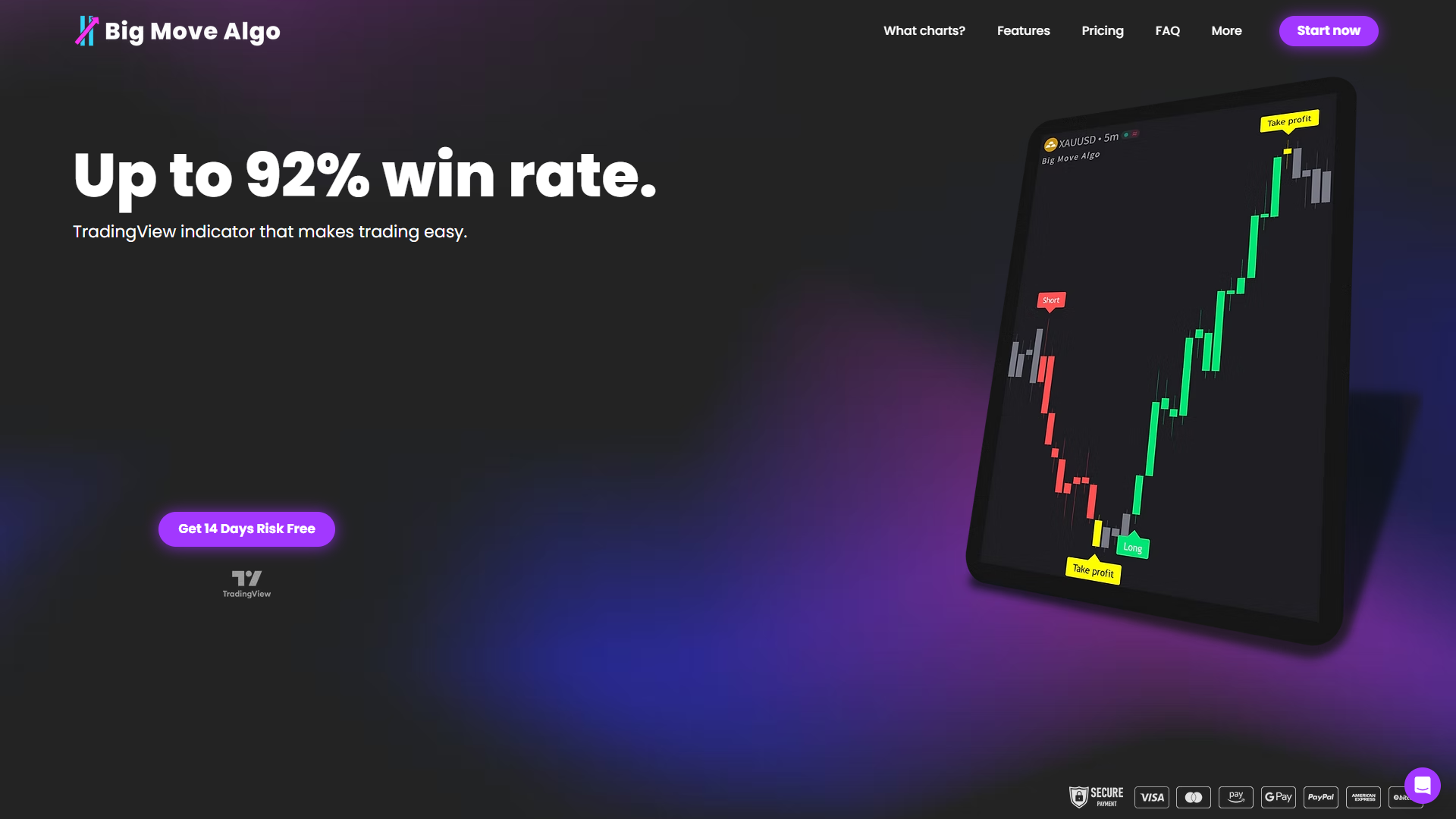
Big Move Algo is a TradingView indicator built for traders who want clear signals without the complexity. It delivers Long, Short, and Exit signals in real time across crypto, forex, stocks, indices, and commodities. The built-in Fake Trend Detector filters out low-quality market conditions so you are not trading when conditions do not support it. AUTO Mode gets you started with minimal setup, which makes it a natural fit for beginners who have just built their trading vocabulary and want to put it to work. Set up your TradingView account and see how structured signals turn terminology into real decisions.
FAQ
What are the most important trading terms for beginners?
The most critical terms are market order, limit order, stop-loss, leverage, margin, spread, pip, and risk-reward ratio. These cover trade execution, cost, and risk management, which are the three areas that affect every trade you place.
What is the difference between balance and equity?
Balance is your account value with no open trades. Equity is your real-time value including all open positions. Equity fluctuates constantly, and margin calls trigger when equity falls below the required maintenance margin level.
How does leverage increase trading risk?
Leverage lets you control a position larger than your capital. At 1:100, a 1% adverse price move eliminates your entire margin on that trade. The same multiplier that increases potential gains increases potential losses by the same factor.
What is a pip in forex trading?
A pip is the standard unit of price movement for most currency pairs, equal to 0.0001 or one ten-thousandth of the quoted price. A move from 1.2050 to 1.2060 represents 10 pips.
Why should beginners trade with the trend?
Trading against the trend is a leading cause of early account losses for new traders. Aligning with the prevailing market direction reduces the number of losing trades and helps beginners build consistent habits before attempting more advanced strategies.
Recommended
Comments