
What Is an Exit Signal in Trading? A Clear Guide


An exit signal in trading is a predefined, rule-based alert that tells a trader when to close a position to secure profits or limit losses. Unlike entry decisions, which get most of the attention, exits drive profitability more directly than entries do. A well-defined exit signal removes the guesswork from one of trading’s hardest questions: when do you get out? This guide breaks down what exit signals are, how they work, and how to build them into a consistent trading process across any market.
What is an exit signal in trading, and what does it include?
An exit signal is a rule-based alert to close a trade, generated either by a technical indicator, an algorithm, or a predefined price condition. The signal fires when specific market criteria are met, removing the need for a judgment call in the moment. That removal of real-time judgment is the entire point.
A complete exit signal typically contains several defined parameters:
Instrument: The asset being traded, such as a stock, forex pair, or crypto token
Trade direction: Whether the position is long or short
Exit price (take profit): The target price at which the trade closes for a gain
Stop-loss price: The level at which the trade closes to cap a loss
Signal trigger: The specific condition that fires the alert, such as a moving average crossover or RSI threshold
These parameters work together as a complete instruction set. Without all of them, a signal is incomplete and leaves room for emotional override.
Pro Tip: Write your exit rules down before you enter any trade. A signal you define in advance is far harder to ignore than one you invent under pressure.

How to identify exit signals using technical indicators
Technical indicators are the most common source of exit signals for retail traders. Each indicator reads price, volume, or momentum data and converts it into a visual cue or numerical threshold that tells you when conditions favor closing a position.
The most widely used indicators for exits include:
Moving averages: A price crossing below its 20-period or 50-period moving average signals weakening momentum and a potential exit point
RSI (Relative Strength Index): Readings above 70 indicate overbought conditions; a drop back below 70 is a common exit trigger for long positions
MACD (Moving Average Convergence Divergence): A bearish crossover of the MACD line below the signal line suggests fading momentum
Candlestick patterns: Reversal patterns like bearish engulfing or shooting star candles at resistance levels serve as visual exit cues
Volume exhaustion: A climactic volume spike at trend extremes signals an imminent reversal before a formal stop loss triggers
Volume exhaustion is particularly underused by newer traders. When price hits a new high or low on a massive volume surge, it often marks the final push of a trend. Experienced traders treat that spike as a warning to exit, not a reason to add to a position.
Using multiple layers of exit signals together, such as combining a candlestick reversal with an RSI reading above 70 and a volume spike, produces stronger confirmation than any single indicator alone. The tradeoff is that waiting for full confirmation can cost some profit. Most traders accept that cost in exchange for higher-probability exits.
Pro Tip: Simple indicators applied consistently outperform complex ones applied inconsistently. Pick two or three indicators, learn their behavior across different market conditions, and stick with them.
What are the main types of exit signals and strategies?
Exit strategies fall into several distinct categories, each with a different trigger mechanism and risk profile. Understanding the differences helps you match the right exit type to your trading style and market conditions.
Exit Type | How it works | Best suited for |
Fixed take profit | Closes at a set price target | Swing and position traders |
Stop-loss order | Closes at a set loss level | All trader types |
Trailing stop | Adjusts with price to lock in gains | Trend-following traders |
Time-based exit | Closes after a defined period | Day traders and scalpers |
Partial exit | Closes a portion of the position | Experienced traders managing risk |
Bracket/OCO order | Places take profit and stop loss simultaneously | Automated and systematic traders |
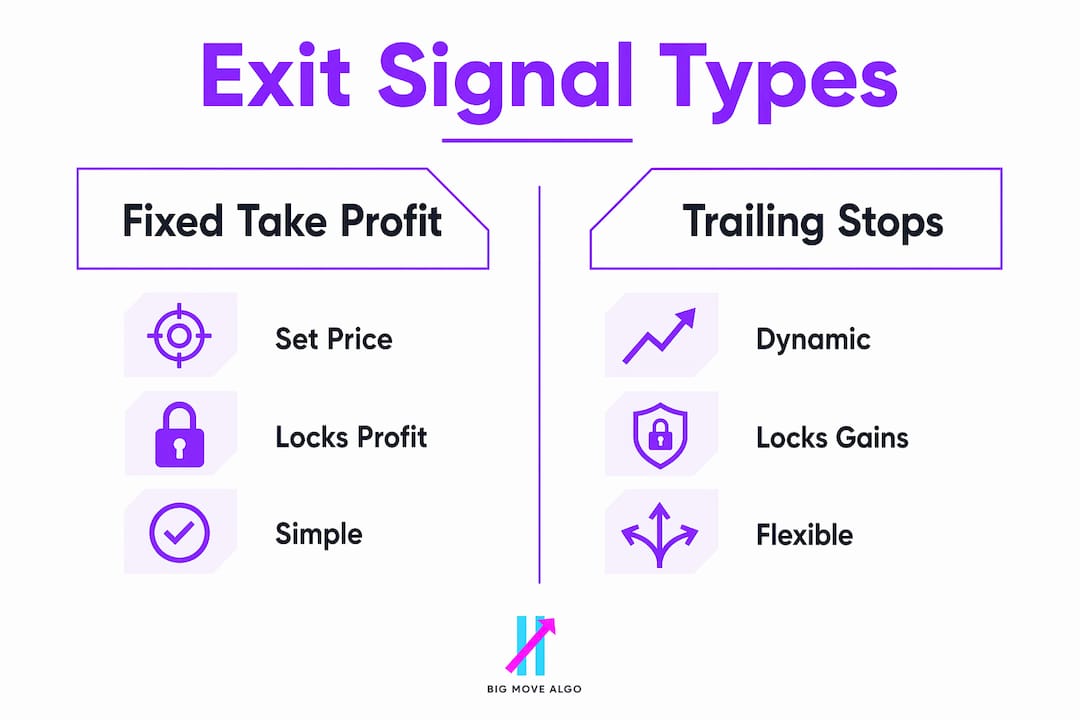
Trailing stops deserve special attention. A trailing stop adjusts dynamically as price moves in your favor, creating a moving floor under your profits. Set as a fixed dollar amount or percentage, it locks in gains without requiring manual intervention. If price reverses by the defined amount, the stop triggers and closes the trade automatically.
Partial exits are a technique used widely by experienced traders. Closing half a position at the first target locks in real profit while keeping the remaining position open for further upside. This approach reduces the psychological pressure of watching a winning trade pull back, because you have already secured a portion of the gain.
Pro Tip: Bracket orders, also called OCO (one cancels the other) orders, let you automate both exits simultaneously. The moment one side fills, the other cancels. This is one of the most practical tools for disciplined trade management.
How exit signals fit into risk management and automated trading
Exit signals do not work in isolation. Their real power comes from being embedded into a broader risk management plan that runs automatically, without requiring you to make decisions under pressure.
Automated exit signals combined with protective order types remove the two biggest enemies of consistent trading: fear and greed. Fear causes traders to exit too early. Greed causes them to hold too long. A pre-set exit signal eliminates both by making the decision before the trade is even open.
The practical benefits of automating exits include:
Capital protection: Stop-loss orders close losing trades at defined levels before small losses become large ones
Profit locking: Trailing stops preserve gains during favorable moves without requiring manual monitoring
Reduced screen time: Automated exits free traders from watching every tick, which reduces stress and impulsive decisions
Consistency: The same rules apply to every trade, which makes performance measurable and improvable
Predefining exit rules before entering a trade prevents emotional decisions and improves both drawdown control and long-term profitability. Sticking to simple, backtested exit rules consistently outperforms complex, indicator-heavy signals that shift with market conditions.
Setting up TradingView indicator alerts is one practical way to automate exit notifications without building a full algorithmic system. When your indicator hits the defined threshold, the alert fires and you act on a pre-made decision rather than an in-the-moment reaction.
Key Takeaways
Exit signals are the most underrated component of a profitable trading system. Defining them before you enter a trade is the single most effective way to protect capital and lock in gains consistently.
Point | Details |
Exit signal definition | A rule-based alert to close a trade at a defined price or condition |
Core components | Every signal needs an instrument, direction, take-profit level, and stop-loss level |
Best indicators | RSI, MACD, moving averages, and volume exhaustion provide the strongest exit cues |
Automation advantage | Bracket and OCO orders remove emotional decisions by executing exits automatically |
Simple beats complex | Fixed rules and basic indicators outperform complex multi-condition signals over time |
Why most traders get exits wrong
Most traders spend the majority of their time studying entries. They obsess over the perfect setup, the ideal indicator combination, the exact moment to get in. Exits get treated as an afterthought, something to figure out once the trade is running.
That is backwards. After years of watching traders work through their results, the pattern is consistent: the entry determines whether you have a trade, but the exit determines whether you have a profit. Two traders can enter the same position at the same price and walk away with completely different outcomes based solely on how they managed the exit.
The most common mistake is exiting by feel. A trade moves against you and the discomfort becomes unbearable, so you close it just before it reverses. Or a trade runs well past your target because you convinced yourself it would keep going, and then you give back the gain. Both of these are emotional exits, and rule-based exit triggers exist specifically to prevent them.
The traders who perform most consistently are not the ones with the most sophisticated systems. They are the ones who define simple, tested exit rules and follow them without exception. A fixed stop loss and a clear take-profit level, applied to every trade, will outperform a complex multi-indicator exit system that gets second-guessed on every position.
My practical advice: test your exit rules on historical data before you trust them with real capital. If a rule does not hold up across different market conditions, it is not a rule. It is a guess dressed up as a system. Keep exits simple, keep them pre-defined, and treat deviation from them as a mistake to correct, not a strategy to explore.
— Steven Hartwell
How Big Move Algo delivers clear exit signals for every trade
Knowing what an exit signal is and actually having one fire at the right moment are two different things. Big Move Algo is a TradingView indicator that generates real-time Long, Short, and Exit signals across crypto, forex, stocks, indices, and commodities.
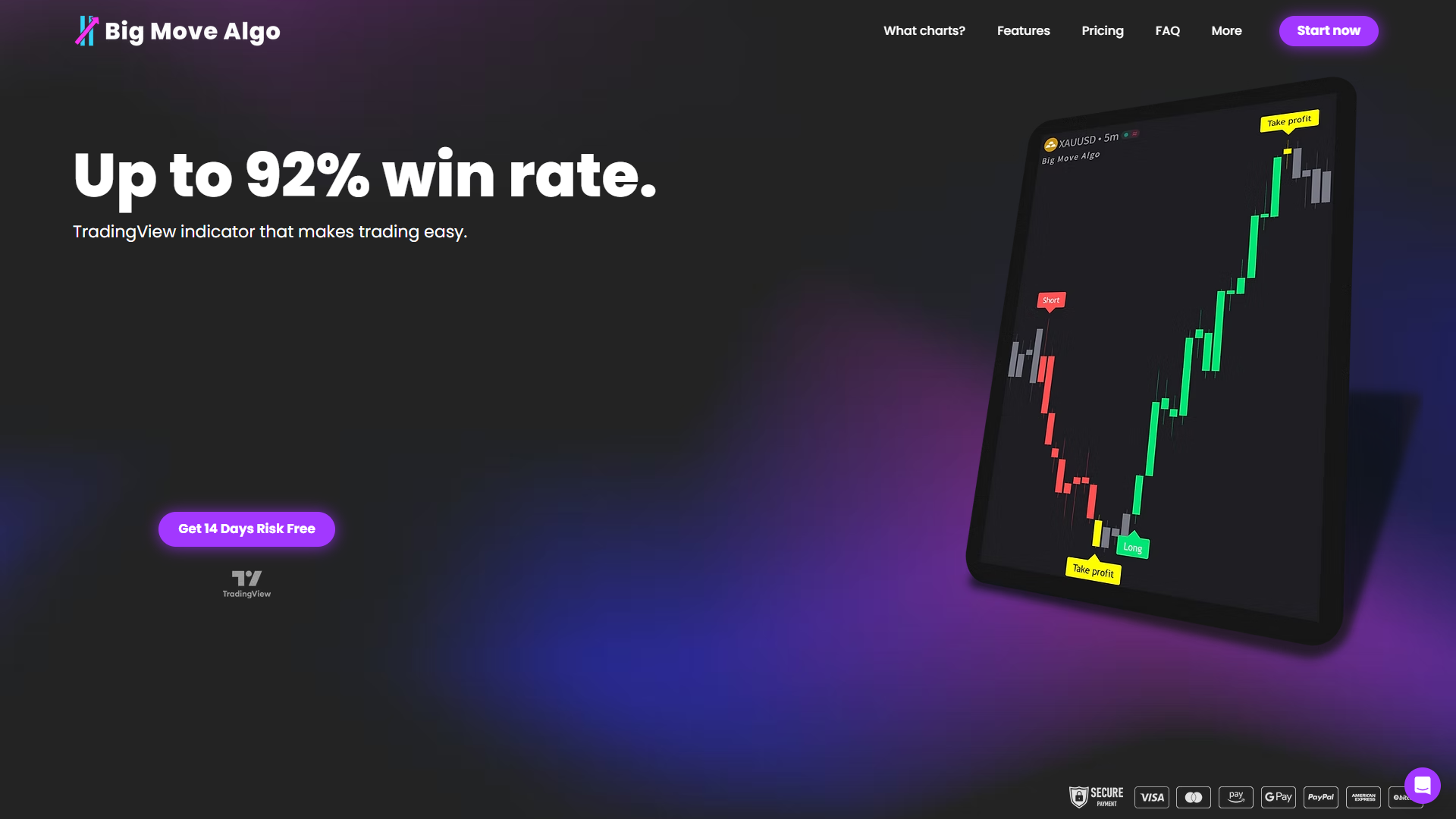
The Exit signal appears directly on your chart when Big Move Algo’s algorithm detects conditions favoring a trade closure. The built-in Fake Trend Detector filters out low-quality market conditions so the signals you receive are based on cleaner data. Traders can start with AUTO Mode for minimal setup or switch to Manual Mode for additional control. If you want clear, structured signals without building your own indicator system from scratch, Big Move Algo is built for exactly that purpose.
FAQ
What does exit signal mean in trading?
An exit signal is a predefined alert telling a trader to close an open position. It is triggered by a technical condition, price level, or algorithm, and is designed to remove emotional decision-making from the exit process.
What are the best indicators for exit signals?
RSI, MACD, moving averages, and volume exhaustion patterns are the most widely used indicators for identifying exit points. Combining two or three of these produces stronger confirmation than relying on any single one.
How do trailing stops work as exit signals?
A trailing stop adjusts automatically as price moves in your favor, locking in profits without manual intervention. If price reverses by the defined amount, the stop triggers and closes the trade.
What is the difference between a stop loss and an exit signal?
A stop loss is one specific type of exit signal that closes a trade at a defined loss level. An exit signal is the broader category that includes stop losses, take-profit orders, trailing stops, and indicator-based alerts.
How do I build a simple exit strategy?
Define a fixed take-profit target and a stop-loss level before entering every trade. Use a bracket or OCO order to place both simultaneously. Review actionable trade signal examples to see how structured exits work in practice.
Recommended
Comments